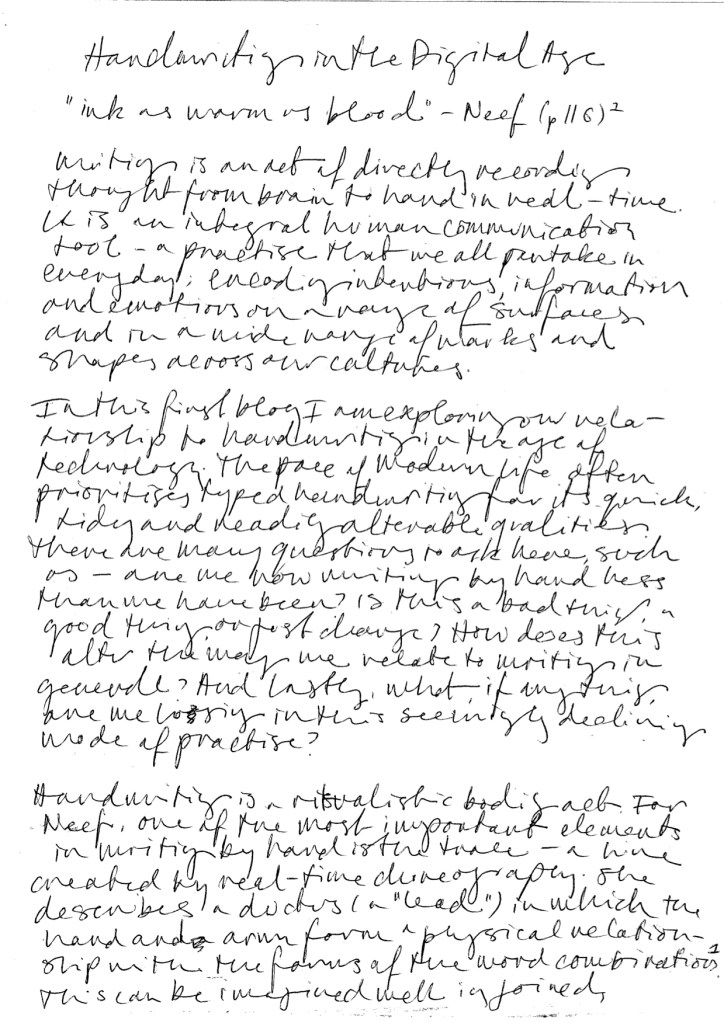
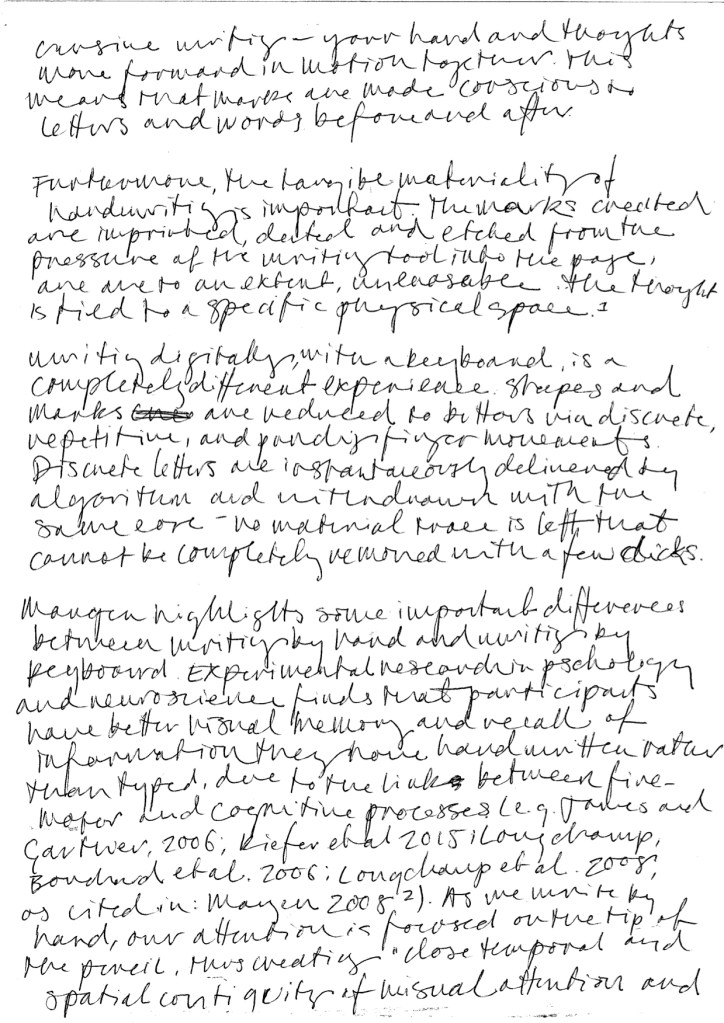
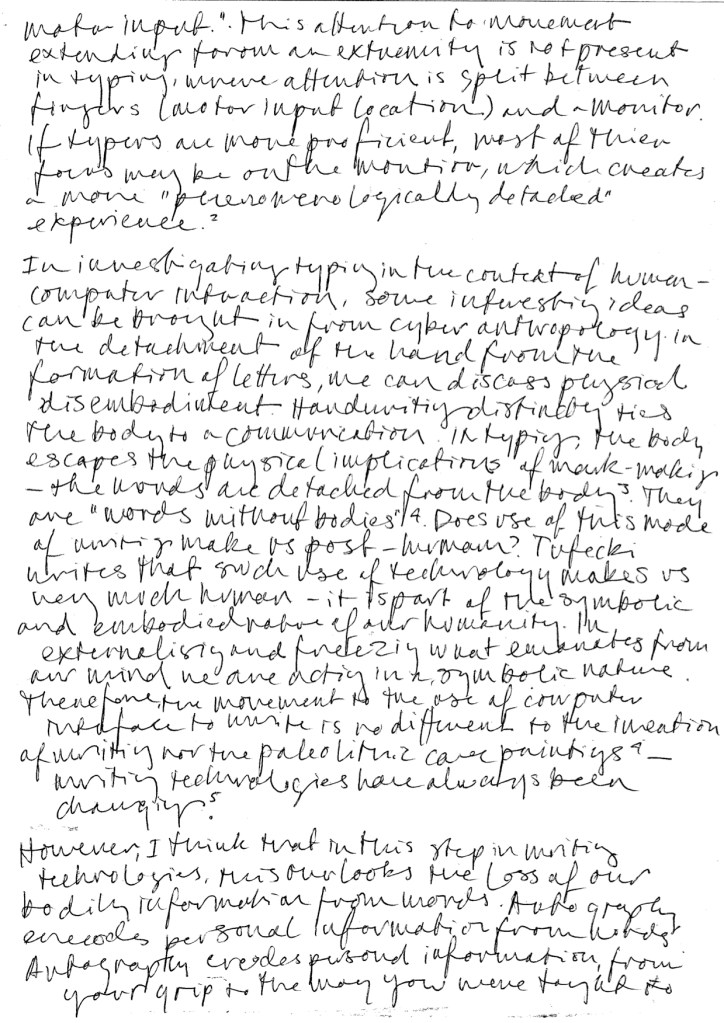
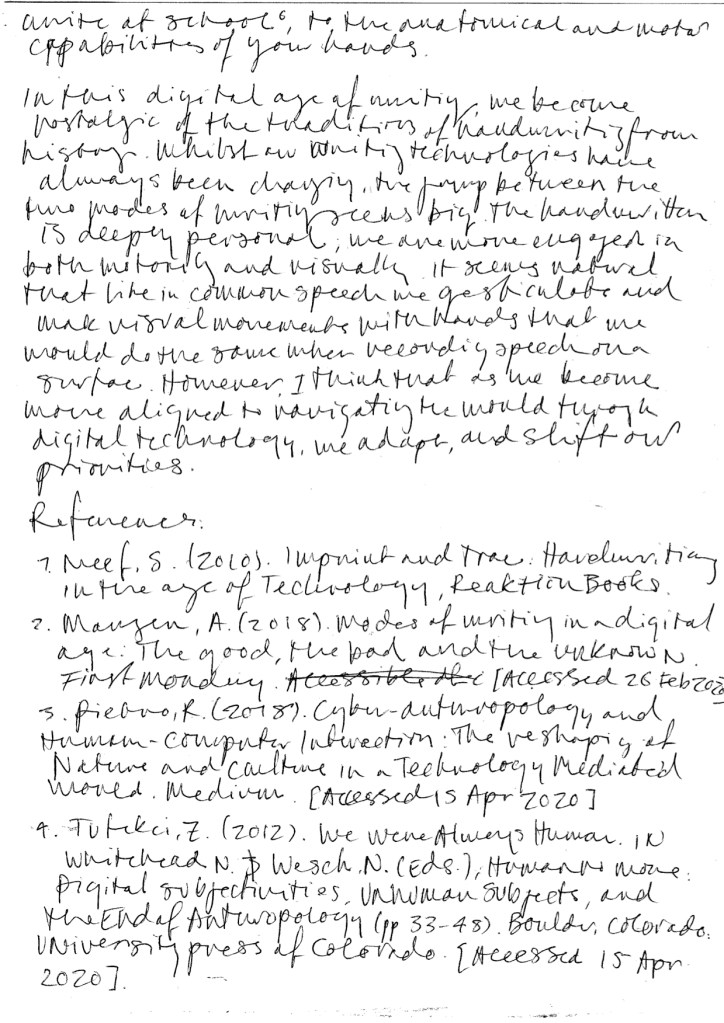
This is a handwritten version of the Handwriting in the Digital Age, find the original (legible) here. I thought that it might serve as an interesting extra to underline points raised within the original post – does the content of the post strike you differently handwritten?
Carter et al. have developed a software using neural networks to generate handwriting modelled on a sample of your own- I’ve posted the link below to the experiment, which allows you to play around with your own writing.
Further to my post on handwriting in the digital age, this again raises the question of embodiment and writing on a digital interface. In my post I compare handwriting, which carries the embodiment of individual bodies, to typing, which is a detached deliverance of letters or characters via code. This sits somewhere between those two posts, offering perhaps partially embodied writing, a hybrid. This feeds into ideas around the boundaries of humanity and cyborgism, or where there are any at all 2.
Tufekci, Z. (2012). We Were Always Human. In WHITEHEAD N. & WESCH M. (Eds.), Human No More: Digital Subjectivities, Unhuman Subjects, and the End of Anthropology (pp. 33-48). Boulder, Colorado: University Press of Colorado. Accessibled at < www.jstor.org/stable/j.ctt4cgr5j.5> [Accessed 15 Apr 2020]
Handwriting interlinks a language with bodily movement. Whilst handwriting shows individuality among persons of a cultural group, I am interested in how we can think about the variance in taught rules between cultures such that writing displays both individual but also specific cultural identity.
Primarily, the language you write in reveals a cultural identity. But this can be broken down into ideas of prescribed movement and posture, as well as handedness. Further, some studies reveal the different biases in the movements and forms of lettering by different language-speaking groups (more later on).
Drawing back to ideas of motor habit patterns from Mauss1 and Farnell’s concept of movement as ‘dynamically embodied culture’ from my previous post, posture is certainly a component in the mechanics of handwriting that is culturally shaped2. Differences in whether we are sitting or standing to write and how we do it changes the angles, shape and contact of our hands with the writing surface.
There are both macro and micro differences in how we conduct ourselves when we write. In a more macro view, we can think about the adoption of different comfortable static positions across cultural groups in general, such as squatting, sitting cross legged, or on a chair, or standing. Postural etiquette too can drive resting posture, such as religious taboos or ideas of decorum. Certainly in english, words such as ‘slouching’, ‘lounging’ and ‘sprawling’ express a negative attitude to a non-straightened back3.
Posture is something that can be instilled from infancy3. Kipsigis, members of a farming community in western Kenya, have special words for the teaching of walking and sitting. From five months, a child is deliberately taught a sitting posture by being set in a shallow hole with blankets supporting the back. In Super’s study, they found that in comparison to these children, American infants spend 2/3rds less time sitting and when they did it was a different posture that utilised the trunk muscles less4.
Whilst I was unable to find many studies on differing modes of finger manipulation applicable to writing, handedness is another culturally entwined motor habit. Hertz discusses the beliefs towards usage of the left or right hand, and how use of the left hand is regularly suppressed amongst many cultures. For example, Maori associate the left as a side of weakness, death and misery, against the sacred right of good and creative powers5. This dualism reflected in the body is fairly common across cultures.
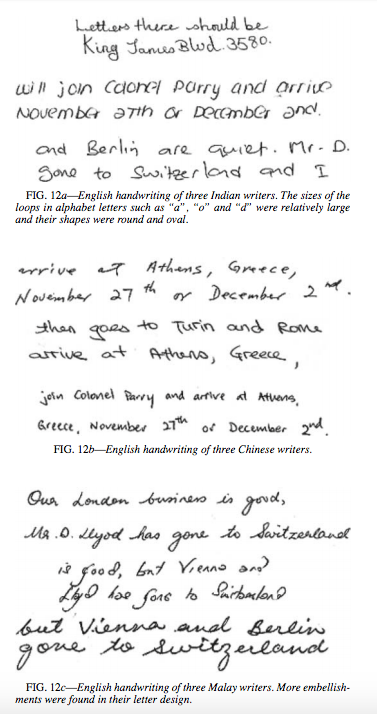
Gleaning ideas of cultural or ethnic identity from handwriting could be quite a complex task. Different cultures do however utilise different standards in the teaching of motor preliminaries for handwriting. Factors such as regularity, neatness, slant, pen lifts, clockwise or counter clockwise movements and pen grasp may be emphasised in early education to different extents6. A study by Cheng et al. examines quantitatively different qualities of Chinese, Malay and Indian natives writing in English. Using this writing system separate from their own highlighted variant writing habits and characteristics. Chinese writing consists of a variety of mark making, just as “heng” (a horizontal stroke), “shu” (a vertical stroke), “gou” (a hook), “pie” (a diagonal stroke falling from right to left) and “tiao” (a diagonal stroke rising from left to right) to name a few. In Arabic, words are written right to left and nearly every letter is joined, whereas in Tamil no letters are joined7. The study found some interesting characteristics:
Indian (Tamil) writers frequently used more long, broad strokes with slight curvature with larger letter size
Chinese (Mandarin) writers used more angular marks, with pen-lifts every 2-3 letters
Malay (Arabic) writers tended to write in an anti-clockwise direction7
Samples of the Indian, Chinese and Malay writing from Cheng et al’s study 7
A further study by Saini and Kapoor looked at differences in english writing between different ethnic groups in Delhi. Some of the significant traits they observed were that the Brahmin group had a moderate right directional slant and characteristically used an inner loop formation in lower case ‘o’, whereas the Panjabi group has a vertical slant and larger line spacing. The Baniya used distinctive rounded ‘m’ humps and the Tamilian group had the smallest line spacing8. By quantitatively breaking down features of writing it is interesting to see what is prioritised collectively by members of the same cultural group.
The question as to whether you can visibly detect cultural identity in handwriting is certainly complex, and could certainly create some generalisations. However, in terms of thinking about the habitus of the body and the movements we make in tune to our cultural influences, the habit of handwriting holds space for interesting anthropological explorations.
References
Mauss, M. (1973). Techniques of the Body. Economy and society, 2(1), 70-88.
Gordon W. Hewes. (1957). The Anthropology of Posture. Scientific American, 196(2), 122-132. Accessible at <https://www.jstor.org/stable/24941890> [Accessed 5 Apr 2020]
Huber, R. A., & Headrick, A. M. (1999). Handwriting identification: facts and fundamentals. CRC press
Cheng, N., Lee, G. K., Yap, B. S., Lee, L. T., Tan, S. K., & Tan, K. P. (2005). Investigation of class characteristics in English handwriting of the three main racial groups: Chinese, Malay and Indian in Singapore. Journal of Forensic Science, 50(1), JFS2004005-8. Accessible at <http://citeseerx.ist.psu.edu/viewdoc/download?doi=10.1.1.486.7667&rep=rep1&type=pdf> [Accessed 5 Apr 2020]
Saini, M., & Kapoor, A (2014). Variability in handwriting patterns among ethnic groups of India. International Journal of Humanities and Social Sciences. 2014b; 1 (3): 49, 60.
“Graffiti is the visual residue of a spatialized performance that speaks to a diverse range of issues from social resistance to enacting identity.” – Tracey Bowen 1
“The possibility of a body that is written upon but also writes” – Susan Leigh Foster 2
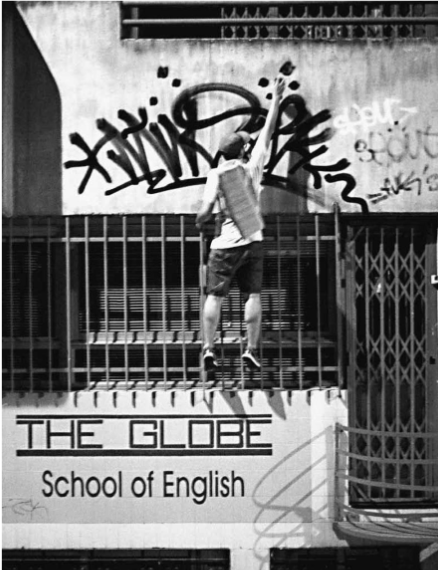
Graffiti is a mode of writing that often carries personal style and habit. Gestures are magnified as the scale of writing is blown up and more parts of the body are engaged, which are therefore put into the work.
I am interested in how graffiti as a form of writing can be about performance, as a bodily act of gestures much more dynamic than perhaps on paper, and how the product of this recorded bodily movement activity shapes space.
Graffiti’s performative qualities are enacted in both the artist as they carry out the act, and as Gell notes, the viewer as they mentally rehearse the piece before them 3. This is particularly central to graffiti writing as viewer’s eyes follow the maker’s mark order as they read the words. In Bowen’s words, graffiti isn’t merely optical, but also a haptic and physical experience 1. This connection is arguably what can cause strong reactions to it 4 .
Within the performative moment of writing graffiti, it is interesting to think about the phenomenology of the body and gestures. Farnell writes about kinesthetic sense and movement as “dynamically embodied signifying acts in symbolically rich spaces”. From this, she describes the importance of bodily knowledge, the phenomenology of it as something we can mutually understand – movement which is meaningful as it is understood through our own bodily knowledge 5.
Nano4814, Untitled, 2009. Retrieved from Schacter, R. (2014). Ornament and order : Graffiti, street art and the parergon / by Rafael Schacter. (Architecture).
Not only are gestures understood in a bodily manner, but they are understood socially as they are embodied culture 6. The idea of embodied culture is reflected by Mauss in Techniques of the body 7, and beyond this Merleau-Ponty goes as far as saying that even reflex actions are socially derived 6.
Movement and gestures are recorded in the graffiti writing, which carry semantic meaning and further emotion and intent understood socially by viewers in the body.
The individual body is connected to space through a material trace of the performance. The material deposit can become a corporeal part of its producer, an “embodiment in an object” 8. Schacter expresses this idea from his fieldwork that graffiti artists felt their work was a personification of themselves, and even a fragment of them, feeling great emotional attachments to their pieces. He even described feelings of physical injury when they were removed 4.
In thinking about space and the individual, it is interesting to think about the bodily gestures and resultant outputs as produced in space but generating space themselves, as theorised by Lefebvre 9. For example, this space generation was observed by Bowden in her observations of graffiti in Lilac Alley in the San Francisco Mission and the Queen Street Alley in Toronto1. The remains of the body in the writing seem to hold small amounts of personal or even private space within the public. This can be, not always intentionally, a territorial effect.
Graffiti-handwriting dynamically scales up the movements of the self which are put into writing. A containment of the individual and their body into a line; the body is inscribed into the work as well as the words. This I think is the most important thing in understanding the significance of handwriting.
References
Bowen, T.(2013). Graffiti as Spatializing Practice and Performance. In: Berry E., Siegel C., 2013. Rhizomes, Issue 25. Available at <http://www.rhizomes.net/issue25/bowen/> [Accessed 2 Apr 2020]
Foster, S. 1995. Cited in: Noland, C. (2009). Agency and Embodiment. Harvard University Press. Available at <https://www.jstor.org/stable/j.ctt13x0jc0.3> [Accessed 27 Mar 2020]
Gell, A. (1998). Art and Agency. Clarendon Press.
Schacter, R. (2008). An Ethnography of Iconoclash: An Investigation into the Production, Consumption and Destruction of Street-art in London. Journal of Material Culture, 13(1), 35–61. Available at <https://journals.sagepub.com/doi/abs/10.1177/1359183507086217> [Accessed 27 Mar 2020]
Mauss, M. (1973). Techniques of the Body. Economy and society, 2(1), 70-88.
Dryden, 2001: 281, Cited in: Schacter, R. (2008). An Ethnography of Iconoclash: An Investigation into the Production, Consumption and Destruction of Street-art in London. Journal of Material Culture, 13(1), 35–61. Available at <https://journals.sagepub.com/doi/abs/10.1177/1359183507086217> [Accessed 27 Mar 2020]
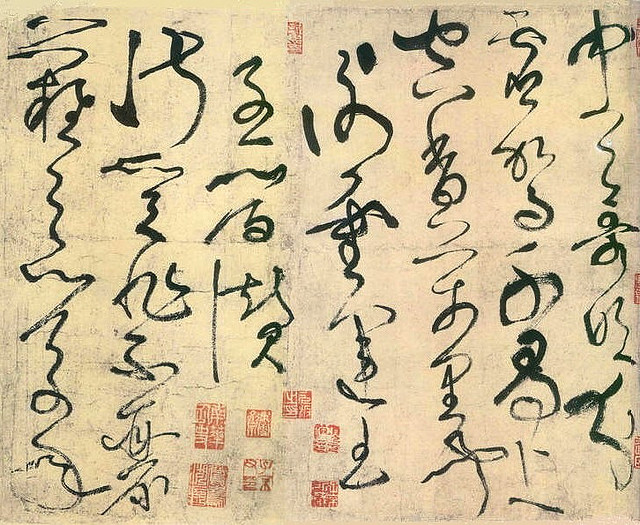
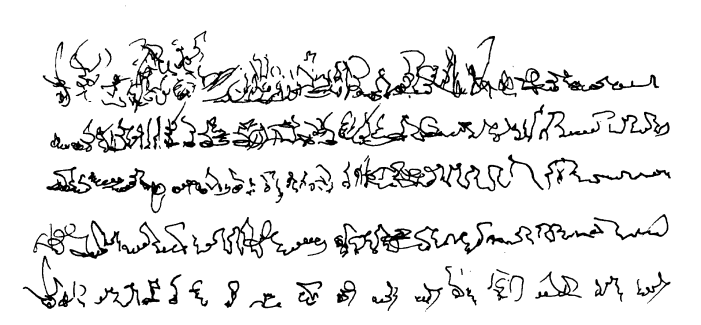
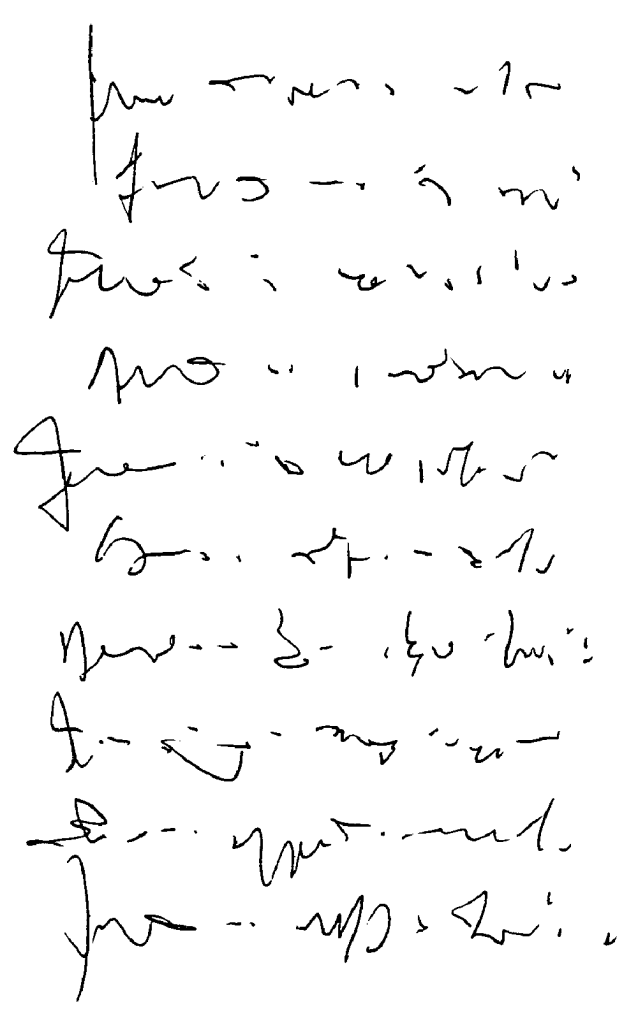
Asemic handwriting is a method of writing, perhaps close to drawing, that extends writing beyond the limits of the common established languages created by societies. It is thus much more orientated around the individual, often being more concerned with conveying thought in a more personal, emotive and spontaneous manner.
Whilst established writing languages carry semantic, emotional and aesthetic meaning, asemic handwriting bypasses the obvious semantic1 arriving at an open product without set meaning2. In summary, if asemic writing was placed on a scale, it would be this: recognisable images, abstract images, asemic writing, legible writing3.
Whilst it may sound unusual, we as people, perhaps unaware, all practise this mode of writing. For example, when we test out a pen or as children when we make mock lettering and pseudo writing when learning how to write2.
The practise of writing in this manner has been practised as far back as the Chinese Tang Dynasty (618-907CE), and widely across cultures. “Crazy” Zhang Xu for example was a calligrapher and poet in the Tang Dynasty who would drink in order to write in this manner (although this is optional). Further examples in more recent years include Henri Michaux, Tim Gaze and Jim Leftwich, who link this methodology of writing to poetic practise4.
The rules of this writing originate from the individual, in comparison to traditional written languages which carry a prescribed, taught format. Discussion of ‘structure vs agency’ in social theory describes the relationship between individual and society well, structure meaning the generalised, fixed features of social life and agency as the actions of the individual5. Scheper-Hughes and Lock highlight the differences between the societal body consisting of structures and relations, and the individual body which is an entity of lived experience, phenomenologically experienced6. Mauss’ Techniques of the Body describes how we learn to use our bodies in respect to societal prescriptions, and we develop cultural habitus7. Bordieu describes this as the perceptual and embodied practises that emerge in an individual over time5.
I’d argue that we see our learned societal habitus both in the way that we learn to write following existing languages, and within the characteristics of our own handwriting shapes. Our individual handwriting can be broken down to ‘style characteristics’, as learned perhaps with the handwriting guides used in school, and ‘individual characteristics’ which are personal to our body anatomy8. The asemic technique is a firm steer towards the latter ‘individual characteristics’ our bodies can produce.
Asemic writing allows us to write/record emotion as phenomenologically experienced in the body, where we might not else be able to express ourselves through the structures of language. Studies show that it can be an effective therapeutic method, such as for adults with alexithymic-schizophrenia3 as it enables a more uninhibited self-expression. There are interesting parallels occuring in anthropological discussion on embodiment and how we experience emotion and are able to describe emotion in writing. Rosaldo (1984, as cited in Lock9) believes that emotions are “culturally constructed labels to subjective feelings”(p.139), as concepts that are semantically different across cultures. Whilst unpacking the phenomenology of the body, she believes that experienced emotions are not just a cognitive judgment or visceral reaction, but both of these and more. They’re elusive and difficult to pin down9. Favret-Saada (1990, as cited in Lock9) agrees, noting that our symbolisation limits our written expression of emotion, and that sometimes emotion is ‘devoid of representation’9.
I think that asemic writing is interesting for its capabilities to express more than normative societally derived languages. It draws in more of the author, as their hand movements on the page and resultant marks are more attuned to a feeling of the individual body than prescribed shapes. Whilst it is probably not useful for the majority of communications, it can help us explore limits that prescribed languages can have on our articulations.
Winston, N., et al, (2016). The Therapeutic Value of Asemic Writing. Journal of Creativity in Mental Health. 11 (2), pp 142-156. [Accessed 8 Mar 2020] Accessible at <https://doi.org/10.1080/15401383.2016.1181019>
Gaze, T & Jacobson, M, (2013). An Anthology of Asemic Handwriting, Brooklyn, NY: punctum books.
Kostouli, T. (2009). A sociocultural framework: writing as social practise. In: Beard et al., The SAGE Handbook of Writing Development. Sage Publications, London.
Scheper-Hughes, N., & Lock, M., (1987). The Mindful Body: A Prolegomenon to Future Work in Medical Anthropology. Medical Anthropology Quarterly,1(1), new series, 6-41. [Accessed 8 Mar 2020] Accessible at <www.jstor.org/stable/648769>
Lock, M. (1993). Cultivating the Body: Anthropology and Epistemologies of Bodily Practice and Knowledge. Annual Review of Anthropology. 22 pp.133-155 [Accessed 8 Mar 2020] Accessible at <https://www.jstor.org/stable/2155843>
Writing is an act of directly recording thought from brain to hand in real-time. It is an integral human communication tool – a practise that we all partake in everyday; encoding intentions, information and emotions on a range of surfaces and in a wide range of marks and shapes across our cultures.
In this first blog I am exploring our relationship to handwriting in the age of technology. The pace of modern life often prioritises typed writing for its quick, tidy and readily alterable qualities.There are many questions to ask here, such as – are we now writing by hand less than we have been? Is this a bad thing, a good thing or just a change? How does this alter the way we relate to writing in general? And lastly, what, if anything, are we losing in this seemingly declining mode of practise?
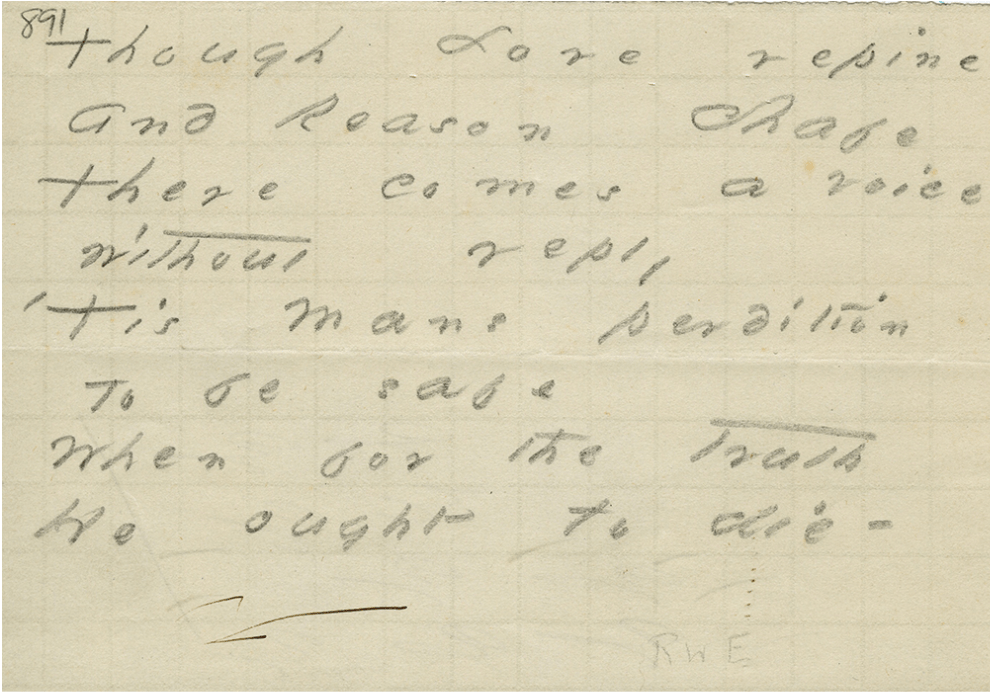
Handwriting is a ritualistic bodily act. For Neef, one of the most important elements in writing by hand is the trace – a line created by real-time choreography. She describes a ductus (a ‘lead’) in which the hand and arm form a physical relationship with the forms of the word combinations1. This can be imagined well in joined, cursive writing – your hand and thoughts move forward in motion together. This means that marks are made conscious to letters and words before and after.
Furthermore, the tangible materiality of handwriting is important. The marks created are imprinted, dented and etched from the pressure of the writing tool into the page, and are to an extent, unerasable. The thought is tied to a specific physical space1.
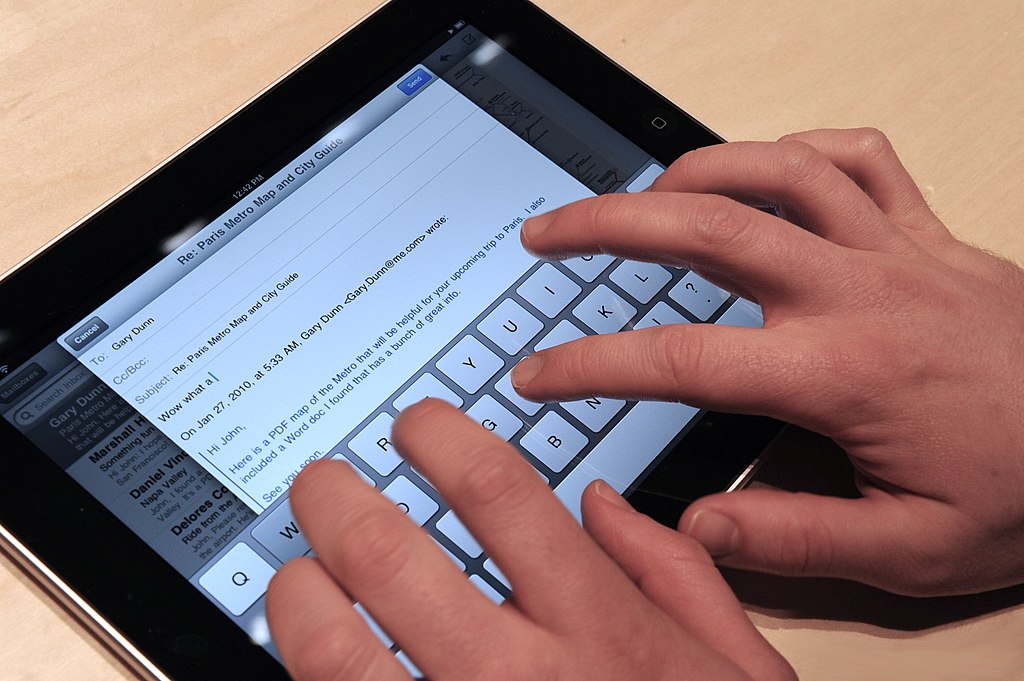
Writing digitally, with a keyboard, is a completely different experience. Shapes and marks are reduced to buttons via discrete, repetitive, and punching finger movements. Discrete letters are instantaneously delivered by algorithm and withdrawn with the same ease- no material trace is left that cannot be completely removed with a few clicks.
Mangen highlights some important differences between writing by hand and writing by keyboard. Experimental research in psychology and neuroscience finds that participants have better visual memory and recall of information they have handwritten rather than typed, due to the link between fine-motor and cognitive processes (e.g., James and Gauthier, 2006; Kiefer, et al., 2015; Longcamp, Boucard, et al., 2006; Longcamp, et al., 2008, as cited in: Mangen, 20082). As we write by hand, our attention is focused on the tip of the pencil, thus creating “close temporal and spatial contiguity of visual attention and motor input”2. This attention to movement extending from an extremity is not present in typing, where attention is split between fingers (motor input location) and a monitor. If typers are more proficient, most of their focus may be on the monitor, which creates a more “phenomenologically detached” experience2.
In investigating typing in the context of human-computer interaction, some interesting ideas can be brought in from cyber anthropology. In the detachment of the hand from the formations of letters, we can discuss physical disembodiment. Handwriting distinctly ties the body to a communication. In typing, the body escapes the physical implications of mark making- the words are detached from the body3. They are “words without bodies” 4. Does use of this mode of writing make us post-human? Tufecki writes that such use of technology makes us very much human – it is part of the symbolic and embodied nature of our humanity. In externalising and freezing what emanates from our mind we are acting in our symbolic nature. Therefore, the movement to the use of computer interface to write is no different to the invention of writing nor the paleolithic cave paintings4 – writing technologies have always been changing5.
However, I think that in this step in writing technologies, this overlooks the loss of our bodily information from words. Autography encodes personal information, from your grip to the way you were taught to write at school6, to the anatomical and motor capabilities of your hands.
In this digital age of writing, we become nostalgic of the traditions of handwriting from history. Whilst our writing technologies have always been changing, the jump between the two modes of writing seems big. The handwritten is deeply personal; we are more engaged in the words both motorily and visually. It seems natural that like in common speech we gesticulate and make visual movements with our hands that we would do the same when recording speech on a surface. However, I think that as we become more aligned to navigating the world through digital technology, we adapt, and shift our priorities.
References:
Neef, S. (2010). Imprint and Trace: Handwriting in the Age of Technology, Reaktion Books.
Tufekci, Z. (2012). We Were Always Human. In WHITEHEAD N. & WESCH M. (Eds.), Human No More: Digital Subjectivities, Unhuman Subjects, and the End of Anthropology (pp. 33-48). Boulder, Colorado: University Press of Colorado. Accessibled at < www.jstor.org/stable/j.ctt4cgr5j.5> [Accessed 15 Apr 2020]
This blog is part of my UCL module on Anthropology of the Body, it’s a space where I hope to explore its functions as an innately personal recorded bodily output.
Here’s some themes and questions that I’d like to explore
Why do we do it, what are the purposes it serves?
How handwriting is learned?
Is it distinct from drawing?
Asemic handwriting , personal ‘codes’
Handwriting as recorded bodily movements, the pen as a prosthetic body part
How handwriting is or isn’t changing in this digital age
My posts will aim to explore these initial ideas, and more as my research and thinking deepens!

 Anthropology of Handwriting
